A Life in Computing and Public Service
Posted on: 11 February 2026 by Eric Howe in Community
.jpg)
The Alumni team recently chatted to Eric Howe, a 1954 Economics alumnus, who shared his remarkable journey through education, early career, computing leadership, and public service in data protection.
From school to scholar: A Journey through education and early career
"The transition from school to work began in Manchester, where a brief stint in the textile industry preceded a life-changing application to Liverpool University. At that time, the university was a much smaller institution, with only 3,500 students.
Tuition was free, and a grant from Lancashire County Council helped cover living costs. The Student’s Union was the heart of social life, with Saturday night dances organised by different societies. Football was a regular pastime, though not with the 1st XI.
Initially enrolled in Commerce in 1951, a switch to Economics followed after one year. Only four students were in the Economics cohort.
Graduating in 1954 with Honours in Economics, the next step was a post with the Medical Research Council. The role involved reporting on working conditions in six North Wales collieries, requiring visits to coal faces and firsthand exposure to the miners’ environment. The conditions I found left me with a great respect for those who worked there.
From 1956 to 1959, work with the National Coal Board focused on modernising costing systems in collieries. This was followed by a post at the Shirley Institute in Manchester, advising textile mills on re-equipment.
In 1961, computing was rapidly evolving. A role at English Electric Computers Ltd involved programming Deuce, a first-generation computer, and conducting system studies. Eventually, this led to a position as Sales Manager for North-West England.
The National Computing Centre (NCC) was founded in 1966 to promote efficient computing in the UK. Here I became Deputy Director and a Board member. Responsibilities included writing the Corporate Plan for a House of Commons Committee, overseeing commercial computing, and leading education and training initiatives.
External roles included chairing a Department of Industry Committee, attending European Commission meetings in Brussels, and serving on the Computer Panel of the National Economic Development Office and a Regional Council of the CBI.
As Chairman of the National Computer Users Forum [NCUF], I helped unify voices from various user organisations. The NCUF was a valuable source of information for Government representatives. This led to an invitation from the European Commission to help establish a similar body in the EU, where I served as the UK representative.
Guardian of privacy: A legacy in data protection and public service
The Data Protection Act was passed in July 1984. It was the first legislation in the United Kingdom to address the use of computers. The Act brought new rights for individuals and new responsibilities for computer users.
The Act also created the post of Data Protection Registrar who was put in a position of independence, being appointed by the Queen and reporting directly to Parliament.
The Registrar was responsible for administering the legislation and raising awareness of data protection in the UK; ensuring individual’s rights; establishing the Register; interpreting the Data Protection Principles and encouraging good practice. The Registrar could issue Enforcement Notices which could be appealed to the Data Protection Tribunal.
I was appointed as Data Protection Registrar and took up office in September 1984. I created a new organisation designed to meet my statutory obligations and located it in Wilmslow in Cheshire.
I established collaborative arrangements with 88 sectoral organisations to support the development of codes of practice. Registration began on 11 November 1985 with 133,000 initial applications, and the Register was made available in 170 libraries.
Media played a vital role in raising awareness. I provided interviews, news releases, school materials, and ran advertising campaigns.
In 1986, I reported that over 900,000 explanatory booklets had been distributed. In that year, the enquiry service had dealt with 81,997 telephone calls and 23,200 letters.
Staff had given 154 talks in 47 locations across the UK. There had been 2,003 press mentions.
I set up an ombudsman service to assist individuals to resolve complaints about the way their personal data was being used. For some weeks after a television advertising campaign, complaints were received at a rate equivalent to around 29,000 per year. An investigation section and legal advisors provided support.
Surveys assessed awareness and effectiveness. Early attention focused on direct marketing and credit referencing. My final report covered diverse areas including the Health Service, the Police and Criminal Justice System, the Banking and Insurance sectors, Local Government and Schools, Advertising and New Technologies.
I was a member of a world-wide Conference of Data Protection and Privacy Commissioners which provided a valuable opportunity to exchange experiences and promote understanding and closer co-operation on an international scale. I also collaborated with EU data protection authorities to form common responses to matters raised by the European Commission. The Registrar was a designated authority in connection with the Council of Europe Convention on automatic processing of personal data and staff attended relevant working parties.
I had a great staff, able, hardworking and enthusiastic. I give them the credit for the positive report on my office from the Public Accounts Committee of the House of Commons in 1994.
,(1).jpg)
A Cartoon in Computer Weekly
The Data Protection Act put us firmly into the problem of balancing conflicting public policies. How should privacy balance against freedom of speech, or the health of the nation, or prevention of crime, or economic benefit? Will the regimentation and monitoring of facts - and sometimes fancies – about people lose individuals the right to say this is my space; this is my information; and this is none of your business. At the other end of the spectrum lies the issue of the power which knowledge and control of information about people might place in the hands of a totalitarian state – Justice, Freedom and Democracy are fragile flowers.
I retired as Registrar in 1994. Before retiring, I chaired an Older People’s Welfare Committee. After retirement, I served as a Board Member and Chairman of a Housing Association.
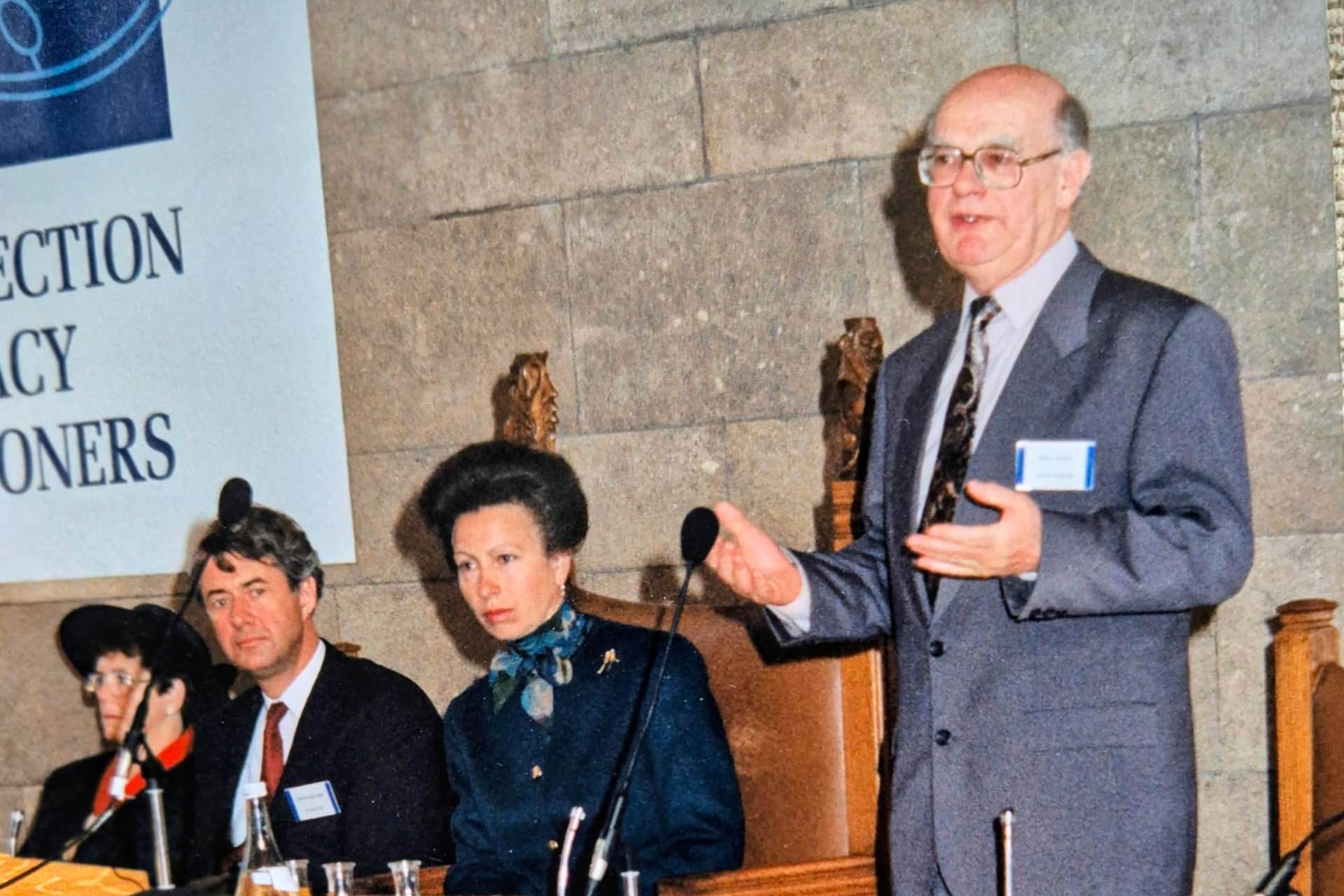
The occasion, in 1993, when I hosted the International Conference of Data Protection and Privacy Commissioners. The Conference was opened by HRH Princess Anne
Professionally, I was a Fellow of the British Computer Society (serving twice on its Council) and a Fellow of the Institute of Data Processing Management. I was honoured to be awarded a CBE in 1990.”
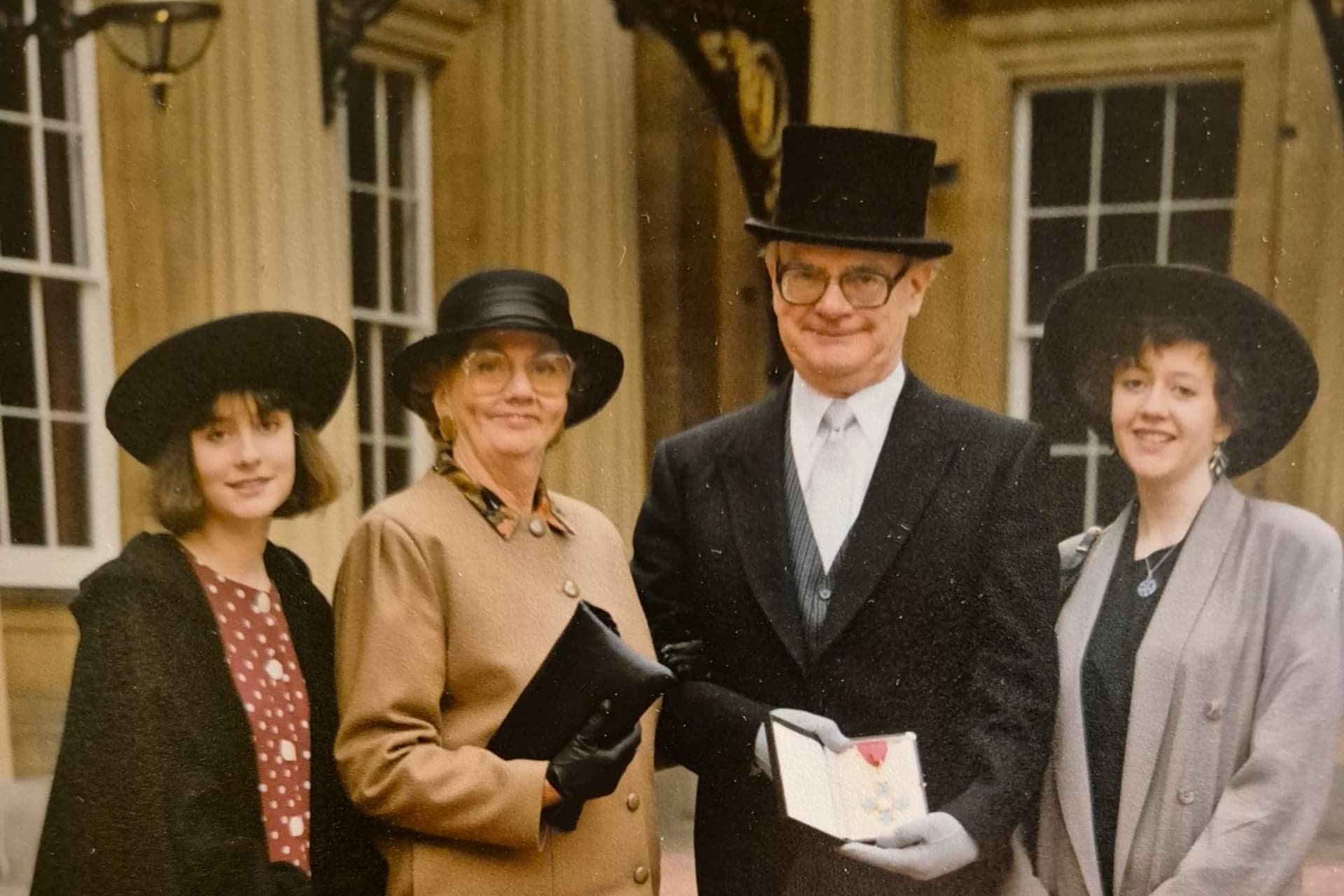 A picture with my wife and daughters taken after receiving the CBE
Keywords: community.